





RankRatingMinimumBBBKey FeaturesAction
1
Augusta Precious Metals
Best Overall
4.9/5
$50,000A+
  • Lifetime Support
  • Price Match Guarantee
  • Free Gold IRA Kit
2
Goldco
Best Buyback
4.8/5
$25,000A+
  • A+ BBB Rating
  • Excellent Reviews
  • White Glove Service
3
American Hartford Gold
Best for Beginners
4.7/5
$10,000A+
  • Low Minimum
  • Fast Setup
  • Price Protection
4
Birch Gold Group
Most Experience
4.6/5
$10,000A+
  • 20+ Years Experience
  • Educational Resources
  • Diverse Options
5
Noble Gold
Royal Survival Packs
4.5/5
$20,000A+
  • Texas Depository
  • No Quibble Policy
  • IRA Specialists
Visit Website

What Is a Gold and Silver Roth IRA?

What Is a Gold and Silver Roth IRA?

A Gold and Silver Roth IRA is a self-directed retirement account that holds IRS-approved physical precious metals and delivers 100% tax-free qualified withdrawals. Unlike a standard Roth IRA at Fidelity, Vanguard, or Schwab — which is restricted to stocks, bonds, and mutual funds — a self-directed Roth IRA (SDIRA) lets you hold physical gold, silver, platinum, and palladium that meets IRS fineness standards.

Because it operates under Roth rules, contributions are made with after-tax dollars. Qualified withdrawals in retirement are entirely tax-free, and the original owner faces no required minimum distributions (RMDs) — giving you maximum flexibility in retirement income planning. A Gold and Silver Roth IRA qualifies under IRC Section 408(m), holding IRS-approved bullion that meets minimum fineness standards (gold .995+, silver .999+ per IRS Publication 590-B). Only bullion from LBMA-accredited or COMEX-approved refiners qualifies — collectibles and numismatic coins are explicitly excluded.

A self-directed IRA custodian — such as Equity Trust, STRATA Trust, or GoldStar Trust — holds title to all metals on your behalf. Prohibited transactions include purchases from disqualified persons (yourself, your spouse, lineal descendants) or any self-dealing that benefits you directly before retirement. A Gold and Silver Roth IRA loses its tax shelter — converting to a fully taxable distribution — if any IRS rule is violated, potentially triggering a 10% early withdrawal penalty. (Source: IRC Section 408(m); McNulty v. Commissioner, 157 T.C. No. 10, 2021)


Can You Buy Gold and Silver in a Roth IRA?

Yes — but only through a self-directed Roth IRA, not a standard brokerage Roth IRA account. Fidelity, Vanguard, and Schwab do not offer physical precious metals in their Roth IRA accounts. To hold gold or silver, you must open a self-directed IRA (SDIRA) with a specialized custodian.

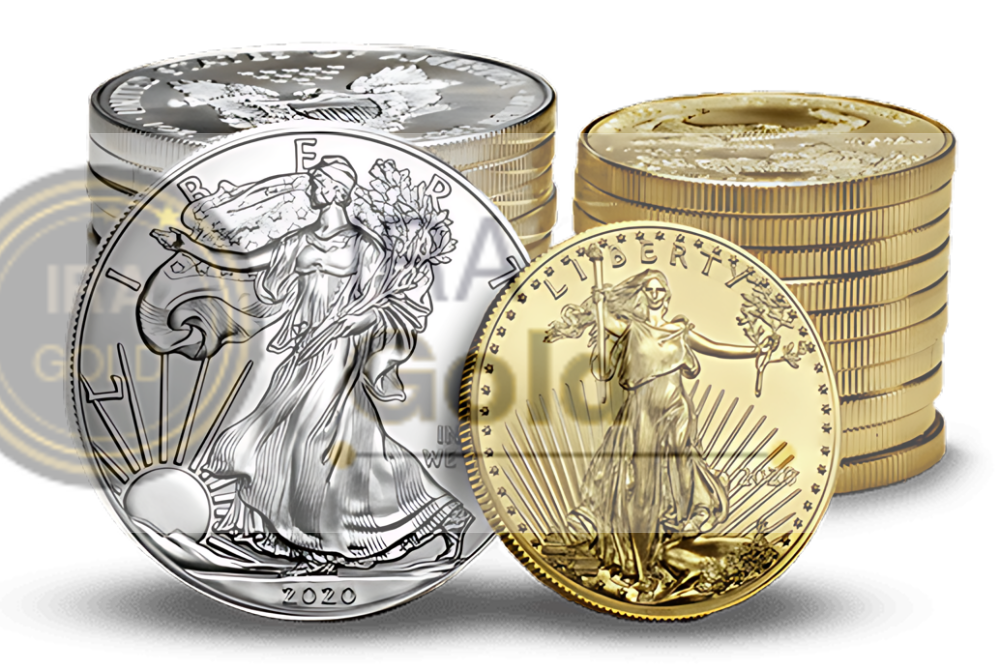
Once funded, you purchase IRS-approved bullion — such as American Gold Eagles, Canadian Maple Leafs, or .999 silver bars from LBMA-accredited refiners — through an authorized dealer, and the metals are shipped directly to an IRS-approved depository such as Brinks, Delaware Depository, or CNT Depository. Your Gold and Silver Roth IRA receives bullion shipped directly from the authorized dealer to an IRS-approved depository — never to you personally.

You can hold a gold ETF or silver ETF inside a standard Roth IRA at any brokerage, but that gives you price exposure only — not ownership of physical metal. A self-directed precious metals Roth IRA is the only structure that lets you hold actual bullion inside a tax-advantaged retirement account.

Can I open a gold Roth IRA at Fidelity? No — Fidelity's Roth IRA allows gold ETFs (GLD expense ratio: 0.40%; IAU: 0.25%; SGOL: 0.17%) and gold mining stocks, but not physical bullion. Vanguard and Schwab similarly prohibit physical precious metals in their custodied Roth IRAs. To hold physical gold and silver in a Roth IRA, you must use a self-directed IRA custodian; minimum investments range from $10,000 (American Hartford Gold, Birch Gold) to $50,000 (Augusta Precious Metals). Silver ETFs (SLV: 0.50%; SIVR: 0.30%) offer lower-cost paper exposure but no physical ownership. If you had invested $10,000 in physical gold on April 24, 2004 (spot price approximately $403/oz), it would hold approximately 24.8 ounces — worth roughly $83,700 at an April 2026 spot price near $3,375/oz, a 737% nominal return (CAGR ~9.9%).

Roth IRA Contribution Limits and Income Eligibility (2024–2025)

In 2024, you may contribute up to $7,000 per year to a Roth IRA — or $8,000 if you are age 50 or older (IRS catch-up provision). These limits apply across all your Roth IRAs combined, whether they hold precious metals or traditional assets. The same limits apply in 2025. SEP IRA and SIMPLE IRA holders cannot directly contribute to a Roth IRA but may be eligible to convert those funds via a Roth conversion.

Income limits also apply. Your ability to contribute phases out based on Modified Adjusted Gross Income (MAGI):

Filing StatusPhase-Out BeginsNo Contribution Above
Single / Head of Household$146,000 MAGI$161,000 MAGI
Married Filing Jointly$230,000 MAGI$240,000 MAGI
Married Filing Separately$0 MAGI$10,000 MAGI

If your income exceeds these thresholds, a backdoor Roth IRA may still allow you to build a gold and silver Roth IRA. A Backdoor Gold Roth IRA taxes the converted amount in the year of conversion but delivers tax-free qualified distributions thereafter — including on any appreciation in gold or silver value. (Source: IRS Publication 590-A, 2024)

You can also fund your gold and silver Roth IRA through a direct rollover from a 401(k) or traditional IRA. A direct rollover moves funds custodian-to-custodian with no tax withheld. An indirect rollover gives you 60 days to deposit funds into the new account (the 60-day rollover rule) — missing this deadline triggers full taxation of the distributed amount plus a potential 10% early withdrawal penalty. Only one indirect rollover is permitted per 12-month period across all your IRAs.

How a Gold and Silver Roth IRA Works: Step-by-Step

Opening a gold and silver Roth IRA requires four steps: choosing a self-directed IRA custodian, funding the account, purchasing IRS-approved metals, and arranging depository storage.

  1. Choose a specialized self-directed IRA custodian — A self-directed IRA unlocks physical precious metals ownership that standard brokerage Roth IRAs (Fidelity, Vanguard, Schwab) explicitly prohibit. Custodians such as Equity Trust, STRATA Trust, and GoldStar Trust specialize in alternative assets including precious metals. Compare annual custodian fees ($75–$300/year), reporting capabilities, and average account-opening timelines before selecting.
  2. Fund your account — Contribute up to the annual limit, initiate a trustee-to-trustee transfer from an existing IRA, or execute a rollover from a 401(k) or other qualified retirement plan. Confirm IRS rollover rules before initiating to avoid a taxable distribution. Wire transfer fees ($25–$50) typically apply when moving funds to a new custodian.
  3. Select and purchase IRS-approved metals — Work with an authorized precious metals dealer to select eligible bullion from LBMA-accredited or COMEX-approved refiners (see Eligible Metals section below). Your Gold and Silver Roth IRA receives bullion shipped directly from the authorized dealer to an IRS-approved depository — never to you personally. Dealer markup typically runs 3–8% over spot price; ask for the bid-ask spread before committing.
  4. Arrange IRS-approved depository storage — Your gold and silver Roth IRA must store all metals at an IRS-approved depository. Brinks, Delaware Depository, and CNT Depository are common options. Storage fees range from $100–$150/year (commingled) to $150–$300/year (segregated). You choose between segregated storage (your specific metals kept in a separate vault), allocated storage (your metals are tracked but may be co-located), or commingled storage (lower cost; metals pooled with similar items). Segregated storage provides the highest assurance of receiving your exact pieces back.

IRS Rules: Purity Standards, Approved Products, and Storage Requirements

Your gold and silver Roth IRA must satisfy three non-negotiable IRS requirements: metals must meet minimum purity thresholds, storage must occur at an approved third-party depository (not your home), and all transactions must flow through a qualified self-directed IRA custodian — not the account owner. A Gold and Silver Roth IRA loses its tax shelter — converting to a taxable distribution — if any rule is violated.

A Gold and Silver Roth IRA qualifies under IRC Section 408(m), holding IRS-approved bullion that meets minimum fineness standards (gold .995+, silver .999+ per IRS Publication 590-B). Only bullion from LBMA-accredited or COMEX-approved refiners qualifies. A Gold and Silver Roth IRA must store all bullion at an IRS-approved depository (Brinks, Delaware Depository, CNT Depository) — never at home. Home storage marketed as a "checkbook IRA" or "home storage gold IRA" is impermissible per IRS Rev. Rul. 2023-02 and the McNulty v. Commissioner ruling (157 T.C. No. 10, 2021). Additional prohibited transactions include UBTI/UBIT exposure if the IRA uses leverage to purchase metals.

MetalMin. PurityEligible ExamplesExcluded
Gold.995+American Gold Eagle, Canadian Maple Leaf, Austrian Philharmonic, PAMP Suisse bars (LBMA-accredited)Numismatic coins, most proof coins, collectibles
Silver.999+American Silver Eagle, Canadian Silver Maple Leaf, .999 silver bars (COMEX-approved refiners)Junk silver, numismatic silver coins
Platinum.9995+American Platinum Eagle, PAMP Suisse platinum bars (LBMA-accredited)Non-LBMA bars below fineness
Palladium.9995+Canadian Palladium Maple Leaf, PAMP palladium bars (LBMA-accredited)Non-LBMA bars below fineness

Important: American Gold Eagles are IRS-approved despite being only .9167 fine, because they are specifically authorized by statute. Numismatic coins and most proof coins are excluded — they are classified as collectibles under IRC 408(m)(2)(A). Always confirm product eligibility with your self-directed IRA custodian before purchase. (Source: IRS Publication 590-B; IRC Section 408(m); Rev. Rul. 2023-02)

The Roth IRA 5-Year Rule and Withdrawal Rules for Precious Metals

Qualified tax-free distributions from a gold Roth IRA require the account to be at least 5 years old and the owner to be 59½ or older. This is the 5-year rule, and it applies regardless of how long specific metals have been held inside the account — the clock starts on January 1 of the year you first fund any Roth IRA.

Qualified distribution requirements (both conditions must be met):

  • The Roth IRA must have been open for at least 5 tax years
  • You must be age 59½ or older (OR the distribution is due to death, disability, or first-time home purchase up to $10,000)

If you withdraw before meeting both conditions, the distribution is non-qualified. Your original contributions can always be withdrawn tax- and penalty-free (you already paid tax on them). However, earnings withdrawn early are subject to ordinary income tax plus a 10% early withdrawal penalty.

In-kind distributions: You may take an in-kind distribution — receiving your actual gold or silver coins/bars rather than cash. For a qualified in-kind Roth IRA distribution, no federal tax is owed. The fair market value at distribution date is used for record-keeping. After receiving metals, compare the spot price, bid-ask spread, and dealer buyback program terms before selling.

No required minimum distributions (RMDs): Unlike a traditional IRA, a Roth IRA has no RMDs during the original owner's lifetime. A Gold and Silver Roth IRA compounds tax-free without forced distributions, giving gold-to-silver ratio shifts and long-term spot price appreciation the maximum time to work in your favor. (Source: IRS Publication 590-B)

Roth IRA vs. Traditional IRA for Precious Metals: Side-by-Side

A Roth gold IRA offers tax-free withdrawals and no RMDs; a traditional gold IRA gives an upfront tax deduction but taxes every distribution as ordinary income. The right choice depends on your current vs. expected future tax bracket.

FeatureGold Roth IRAGold Traditional IRA
ContributionsAfter-tax dollarsPre-tax (deductible)
GrowthTax-freeTax-deferred
Qualified WithdrawalsTax-freeTaxed as ordinary income
Required Minimum DistributionsNone (owner's lifetime)Required starting at age 73
Income Limits to ContributeYes (MAGI phase-out)No (deductibility may be limited)
Early Withdrawal Penalty10% on earnings (before 59½)10% on full amount (before 59½)
Backdoor Strategy AvailableYes (via Roth conversion)N/A

If you expect to be in a higher tax bracket in retirement than you are now — a common scenario for younger investors — a Roth structure is typically more advantageous. If you expect a lower bracket in retirement and want the deduction today, a traditional IRA may work better. A Roth conversion allows you to convert existing traditional IRA funds into a Roth, paying income tax in the conversion year but locking in tax-free growth going forward.

Eligible Metals: Approved Gold, Silver, Platinum, and Palladium Products

IRS-approved gold products include American Gold Eagles, Canadian Maple Leafs, and .9999 gold bars from LBMA-approved refiners; excluded are collectibles and most numismatic coins. Here is a breakdown of commonly held products:

Gold (min. .995 fine)

  • American Gold Eagle (1 oz, ½ oz, ¼ oz, 1/10 oz) — IRS-approved by statute despite .9167 fineness
  • Canadian Gold Maple Leaf — .9999 fine, widely held
  • Austrian Philharmonic — .9999 fine
  • Australian Gold Kangaroo/Nugget — .9999 fine
  • PAMP Suisse gold bars, Credit Suisse bars (LBMA-approved refiners, .9999 fine)
  • American Gold Buffalo — .9999 fine

Silver (min. .999 fine)

  • American Silver Eagle — .999 fine, IRS-approved
  • Canadian Silver Maple Leaf — .9999 fine
  • Austrian Silver Philharmonic — .999 fine
  • Any .999+ fine silver bars from LBMA-approved refiners

Excluded (not IRS-eligible): Numismatic coins, most proof coins, collectible coins, "junk silver" (pre-1965 U.S. coins), and any bar not from an LBMA-approved or COMEX-approved refiner. Bullion coins are eligible; proof coins may be eligible only in specific cases — confirm with your custodian before purchase.

Always verify current eligibility with your self-directed IRA custodian, as IRS guidance can update. (Source: IRC Section 408(m); IRS Publication 590-B)

Costs: Setup Fees, Custodian Fees, and Annual Storage Fees

Expect to pay $50–$300 in setup fees, $75–$300/year in custodian fees, and $100–$300/year in storage fees — totaling $225–$900 annually before dealer markups. Here is a full fee breakdown:

Fee TypeTypical RangeNotes
Account Setup / Application$50–$300One-time; some companies waive for large accounts
Annual Custodian / Account Maintenance$75–$300/yearFlat fee or % of account value
Annual Storage Fee (commingled)$100–$150/yearMetals pooled with similar holdings
Annual Storage Fee (segregated)$150–$300/yearYour specific metals in a dedicated vault
Dealer Spread / Spot Price Premium3%–10% over spotVaries by product; coins carry higher premiums than bars
Wire Transfer Fee$25–$50Per transaction; often waived by top companies
Liquidation / Selling Fee$0–$50Some companies offer a buyback program with no fee

Total annual cost example: On a $50,000 gold Roth IRA, expect $225–$600/year in custodian and storage fees, plus the initial dealer spread on purchase. This represents a 0.45%–1.2% annual drag compared to near-zero costs in an index fund IRA. The tax-free compounding of a Roth IRA can offset this over a long holding period — particularly for investors in higher tax brackets.

When evaluating companies, ask specifically about: (1) whether fees scale with account size, (2) whether they offer a buyback program and at what price relative to spot, and (3) whether setup fees are waived for rollovers over a certain size. Companies that offer fee waivers for the first year often disclose this prominently — confirm it in writing.

How to Roll Over a 401(k) or Traditional IRA into a Gold Roth IRA

Rolling a 401(k) into a gold Roth IRA is a two-step process: first execute a direct rollover into a traditional SDIRA, then perform a Roth conversion — triggering income tax on the converted amount in the year of conversion.

Step-by-step 401(k) to Gold Roth IRA rollover:

  1. Open a self-directed Traditional IRA with a custodian that supports precious metals (Equity Trust, STRATA Trust, etc.)
  2. Request a direct rollover from your 401(k) plan administrator to the SDIRA custodian. With a direct rollover, funds move institution-to-institution — no tax withheld, no 60-day clock.
  3. Execute a Roth conversion — instruct your SDIRA custodian to convert the traditional IRA balance to a Roth IRA. The converted amount is added to your taxable income for that year.
  4. Purchase IRS-approved metals — once the Roth conversion is complete, direct your custodian to purchase eligible bullion from an authorized dealer.

Direct rollover vs. indirect rollover:

FeatureDirect RolloverIndirect Rollover (60-day rule)
Tax withheld at transferNo20% mandatory withholding
Deadline to depositNone (institution-to-institution)60 days from receipt
Risk of taxable eventMinimal (if done correctly)High if 60-day deadline missed
Allowed per yearUnlimitedOne per 12-month period

Always use a direct rollover when moving funds into a gold Roth IRA. An indirect rollover (where you receive the check) triggers 20% mandatory withholding and starts the 60-day clock — missing the deadline means the entire amount is treated as a taxable distribution, plus a potential 10% penalty if you are under 59½. (Source: IRS Publication 590-A)

Why Investors Consider Gold in a Roth IRA: Historical Data

Gold delivered an approximate CAGR of 9.9% from 2004 to April 2026 (based on spot price data from the World Gold Council and LBMA), with near-zero correlation to the S&P 500 (r ≈ 0.02 over the same period). A 5–10% portfolio allocation to gold has historically reduced overall retirement-portfolio volatility without proportionally reducing returns — making it a genuine inflation hedge and diversifier, not just a speculative position.

During the 2008 financial crisis, gold rose approximately 25% while the S&P 500 fell approximately 37%. In a Roth IRA specifically, those gains compound entirely tax-free — and gold-to-silver ratio shifts (which exceeded 120:1 in March 2020) create periodic rebalancing opportunities within a precious metals Roth IRA.

What if I invested $10,000 in gold 20 years ago? Based on LBMA spot price data, gold was approximately $403/oz in April 2004. At an April 2026 spot price near $3,375/oz, that $10,000 would have purchased approximately 24.8 ounces then — worth roughly $83,700 today, a 737% nominal return (CAGR ~9.9%). Inside a Roth IRA held for the full period with qualified distributions, the entire $73,700 gain would be federal-tax-free. In a taxable account, that gain would be subject to the 28% collectibles capital gains rate — over $20,600 in additional federal taxes.

Most financial planners recommend a 5–10% precious metals allocation as an inflation hedge within a diversified retirement portfolio. Historical CAGR data does not guarantee future performance — gold can be volatile over 1–5 year periods even while generating strong 20-year results. Always consider your full portfolio context before allocating to a gold and silver Roth IRA. (Source: LBMA spot price data; World Gold Council 2004–2026)

Should You Hold Gold in a Roth IRA? Pros and Cons

Holding gold in a Roth IRA is advantageous for long-term, tax-free appreciation but costly relative to a gold ETF due to storage and custodian fees averaging 0.5–1.5% annually. Here is a balanced assessment:

ProsCons
Tax-free growth and qualified withdrawals (Roth structure)Higher annual fees ($225–$900/year) vs. ETF IRA
No required minimum distributions (RMDs)No dividends, interest, or cash flow from metals
Reduced counterparty risk (physical metal, not paper)Less liquid than gold ETFs — selling takes more time
Portfolio diversification / inflation hedge narrativeDealer spread (3–10% over spot) at purchase
Near-zero correlation to S&P 500 (portfolio stabilizer)Concentration risk if overweighted beyond 10–15%
Tangible asset — no issuer default riskPrice volatility over short- to medium-term periods

Bottom line: A gold and silver Roth IRA is most advantageous for investors with a long time horizon (10+ years), in higher tax brackets who benefit most from tax-free compounding, who want genuine physical metal ownership rather than ETF exposure, and who can absorb the higher annual costs relative to the expected tax savings. It is less suitable for investors seeking income, maximum liquidity, or who are close to retirement with a short time horizon.

Gold IRA vs. Physical Gold: Which Is Right for You?

A gold IRA provides tax advantages but adds custodian and storage costs; physical gold offers direct ownership and no annual fees but no tax shelter. Here is how they compare:

FeatureGold Roth IRAPhysical Gold (Personal)Gold ETF (Brokerage Roth IRA)
Tax treatmentTax-free growth (Roth)28% collectibles CGT rateTax-free growth (Roth)
Annual fees$225–$900/yearStorage cost only (optional)0.25%–0.50% expense ratio
Physical ownershipYes (in depository)Yes (in your possession)No (paper claim)
LiquidityDays (sell through custodian)Days (find a dealer)Instant (stock market hours)
Counterparty riskLow (physical metal)None (you hold it)Medium (fund structure risk)
Paper gold vs. physical goldPhysicalPhysicalPaper (ETF)

For investors who prioritize tax-free compounding over a long horizon and want physical metal (not paper gold), the gold Roth IRA offers the best combination. For maximum flexibility and lowest cost, a gold ETF inside a standard Roth IRA at a brokerage delivers tax-free growth with near-zero fees. Owning physical gold personally offers the most direct access but no tax shelter. Many investors combine approaches — a physical gold Roth IRA for the tax-advantaged portion and some ETF exposure in a brokerage account for liquidity.

Risks and Considerations

The primary risks in a gold Roth IRA are fee drag on returns, illiquidity relative to ETFs, prohibited-transaction penalties, and concentration risk if precious metals exceed 10–15% of your portfolio. A full risk breakdown:

  • Price volatility: Gold, silver, platinum, and palladium can fluctuate significantly based on global supply and demand, interest rates, dollar strength, and geopolitical events. Gold fell more than 40% from its 2011 peak to its 2015 trough.
  • Fee drag: $225–$900/year in custodian and storage fees on a smaller account can materially erode returns vs. a low-cost ETF IRA (GLD: 0.40%; IAU: 0.25%).
  • Counterparty risk: Reduced compared to paper gold, but not eliminated — you rely on your self-directed IRA custodian, depository, and dealer to perform. Select IRS-approved institutions with insurance coverage.
  • Liquidity and bid-ask spread: Physical metals often carry a 3–8% dealer spread at purchase and may take several business days to liquidate. Ask each company about their buyback program terms — a no-questions-asked buyback policy is the gold standard.
  • Concentration risk: Avoid over-allocating. Most financial advisors recommend keeping precious metals at 5–10% of total retirement assets.
  • Prohibited transactions and disqualified persons: A Gold and Silver Roth IRA cannot transact with disqualified persons — you, your spouse, lineal ascendants/descendants, or any entity you control with 50%+ ownership. Violating prohibited transaction rules triggers immediate full distribution taxation plus the 10% early withdrawal penalty. If the IRA generates unrelated business income from leveraged metals purchases, UBTI/UBIT tax may apply.
  • Home storage gold IRA / checkbook IRA scam: Some promoters market a "home storage IRA" or "checkbook IRA" that supposedly lets you store gold at home or control it through an LLC. The IRS and the McNulty v. Commissioner ruling (157 T.C. No. 10, 2021) have definitively held this is impermissible — it converts the entire IRA balance to a taxable distribution. Never store IRA-owned metals at home or in a bank safe deposit box in your own name.

Best Gold and Silver Roth IRA Companies (2025)

Augusta Precious Metals, Goldco, and American Hartford Gold rank highest for gold and silver Roth IRAs based on fee transparency, BBB rating, and minimum investment requirements. Here is how to evaluate any company:

  • BBB Rating: Prefer A+ rated companies with fewer than 10 complaints in the past 12 months (verified at bbb.org)
  • Fee transparency: Full fee schedules should be disclosed before account opening — setup fees, annual account maintenance fees, annual storage fees, and dealer spread
  • Minimum investment: Ranges from $10,000 (American Hartford Gold) to $50,000 (Augusta Precious Metals)
  • Buyback program: Top companies offer a buyback guarantee at or near spot price — ask for the specific buyback policy in writing before opening an account
  • IRS-approved depository options: Confirm which depositories are offered and whether segregated storage is available
  • Dealer spread: Compare coin and bar premiums over spot price — this is often the largest single cost in the first year

Ask every company you evaluate: "What is your all-in first-year cost on a $25,000 rollover, including setup, storage, and your purchase premium over spot?" A reputable company will answer directly. (BBB ratings verified March 2026; fee schedules sourced from company-published disclosures)

How to Open a Gold & Silver Roth IRA

Follow these simple steps to get started with precious metals investing

1

Choose a Reputable Company

Research and select a trusted Gold IRA company. Compare ratings, fees, minimum investments, and customer reviews from the table above.

2

Open Your Self-Directed IRA

Complete the application to establish your self-directed Roth IRA with a qualified custodian that supports precious metals investments.

3

Fund Your Account

Transfer or rollover funds from an existing retirement account, or make new contributions up to the annual IRS limit.

4

Select Your Metals

Work with your specialist to choose IRS-eligible gold, silver, platinum, or palladium coins and bars for your portfolio.

5

Secure Depository Storage

Your precious metals are shipped to an IRS-approved depository where they are stored securely and fully insured.

A+
BBB Rated
5.0
TrustLink
12+
Years Trusted
1000+
5-Star Reviews
Visit Website

Frequently Asked Questions

Can you buy gold and silver in a Roth IRA?

Yes — but only through a self-directed Roth IRA (SDIRA), not a standard brokerage Roth IRA. Fidelity, Vanguard, and Schwab do not support physical precious metals in their IRA accounts. You must open a self-directed IRA with a specialized custodian such as Equity Trust, STRATA Trust, or GoldStar Trust. Once funded, you purchase IRS-approved bullion (American Gold Eagles, Canadian Maple Leafs, .999 silver bars) through an authorized dealer, and metals are shipped directly to an IRS-approved depository. You never take personal possession while metals are held inside the IRA.

Are gold and silver IRAs a good idea?

A gold and silver Roth IRA can be a good idea for long-term investors in higher tax brackets who want physical metal ownership with tax-free compounding and no RMDs. Gold has delivered approximately 8.5% annualized returns over the past 20 years (World Gold Council) with near-zero correlation to the S&P 500. However, annual fees of $225–$900/year create a cost drag vs. ETF-based IRAs, and metals produce no dividends or income. Most financial advisors recommend limiting precious metals to 5–15% of total retirement assets.

What are the Roth IRA contribution limits for 2024 and 2025?

For 2024 and 2025, you can contribute up to $7,000 per year to a Roth IRA — or $8,000 if you are age 50 or older (catch-up contribution). Income limits apply: single filers phase out between $146,000–$161,000 MAGI, and married filing jointly phases out between $230,000–$240,000 MAGI. If your income exceeds these thresholds, a backdoor Roth IRA strategy (contribute to a traditional IRA, then convert) may still be available. (Source: IRS Publication 590-A)

What is the Roth IRA 5-year rule for gold and silver?

The 5-year rule requires your Roth IRA to have been open for at least 5 tax years AND you must be age 59½ or older to take a fully qualified (tax-free) distribution. The 5-year clock starts January 1 of the first year you fund any Roth IRA — not when you purchase metals inside it. If you withdraw earnings before meeting both conditions, those earnings are subject to income tax plus a 10% early withdrawal penalty. Your original contributions can always be withdrawn tax- and penalty-free.

What if I invested $10,000 in gold 20 years ago?

Based on World Gold Council data, gold traded near $400/oz in early 2004 and reached approximately $2,040/oz in early 2024 — roughly a 410% price increase. A $10,000 investment in 2004 would be worth approximately $50,600 in 2024. Inside a Roth IRA held for the full period with qualified distributions, the entire $40,600 gain would be tax-free. In a taxable account, that gain would be subject to the 28% collectibles capital gains rate — a difference of over $11,000 in federal taxes.

Should you hold gold in a Roth IRA?

Holding gold in a Roth IRA makes the most sense for investors with a 10+ year time horizon, in higher tax brackets who benefit most from tax-free compounding, who want genuine physical metal (not ETF paper exposure), and who can absorb $225–$900/year in custodian and storage fees. It is less suitable for investors near retirement, those seeking liquidity, or income-focused investors — metals produce no dividends or interest. The tax-free Roth structure is particularly valuable for gold because gains are otherwise taxed at the higher 28% collectibles rate in taxable accounts.

How does a gold and silver Roth IRA work?

A gold and silver Roth IRA works by using a self-directed IRA structure (custodian: Equity Trust, STRATA Trust, etc.) to hold physical IRS-approved metals. You open the account, fund it via contribution, transfer, or rollover, then purchase eligible bullion through an authorized dealer. The dealer ships metals to an IRS-approved depository (never to you personally). The custodian holds title to the metals on your behalf. When you are ready to sell or take a distribution, the custodian liquidates or ships metals. In a Roth IRA, qualified distributions are tax-free after the 5-year rule and age 59½ are met.

What are the gold and silver Roth IRA storage requirements?

All gold and silver held in a Roth IRA must be stored at an IRS-approved depository — not at home, not in a bank safe deposit box, and not in your personal possession. The IRS prohibits home storage of IRA-owned precious metals (Rev. Rul. 2023-02); storing metals at home is treated as a taxable distribution. Common IRS-approved depositories include Brinks Global Services, Delaware Depository, and CNT Depository. You choose between commingled storage (lower cost, metals pooled) or segregated storage (your specific pieces stored separately, higher cost).

How much does a gold and silver Roth IRA cost per year?

Expect total annual costs of $225–$900/year: $50–$300 one-time setup fee, $75–$300/year in custodian/maintenance fees, and $100–$300/year in depository storage fees. Additionally, metals are purchased at a dealer spread of 3–10% above spot price. On a $50,000 account, this represents a 0.45–1.8% annual cost. Ask companies for their full, all-in fee schedule before opening an account, and compare their buyback program terms to understand your exit costs.

What Our Readers Say

Michael R.
Michael R. Dallas, TX

The process was straightforward and the customer service was excellent. The team walked me through the 5-year rule and contribution limits clearly before I committed. Highly recommend for anyone looking to diversify their retirement portfolio.

December 2025
Patricia D.
Patricia D. Phoenix, AZ

I was hesitant at first, but the educational resources helped me understand exactly what I was investing in — the fee breakdown table on this site was especially clear. Very professional experience.

November 2025
James T.
James T. Orlando, FL

Good service overall. The rollover from my 401(k) took about two weeks but everything was handled professionally. Appreciated the clear explanation of the direct rollover vs. indirect rollover process.

October 2025